
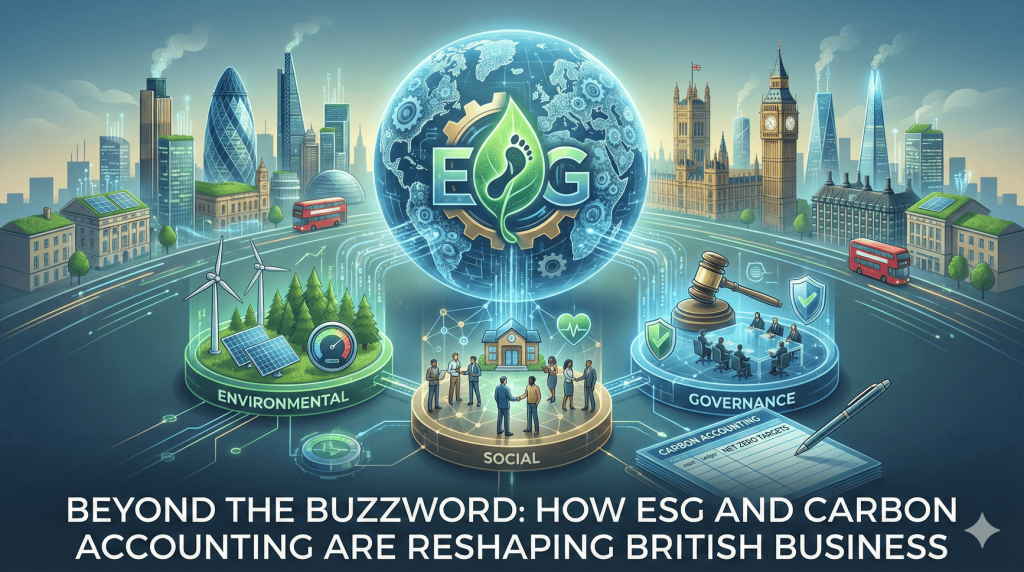

In the corridors of power in London, the boardrooms of FTSE 100 companies, and the business plans of ambitious SMEs, a quiet revolution is underway. The acronyms ESG (Environmental, Social, and Governance) and Carbon Accounting have evolved from niche concerns to central pillars of corporate strategy. For UK businesses, this is no longer a matter of optional philanthropy or simple compliance; it is a fundamental reassessment of how value is created, risk is managed, and long-term resilience is built.
This comprehensive guide delves into the intricate world of ESG and Carbon Accounting within the UK context. We will explore the powerful drivers behind this shift, the evolving regulatory landscape, the practical challenges of implementation, and the tangible opportunities for businesses that choose to lead rather than follow.
Part 1: Deconstructing the Jargon – What Do ESG and Carbon Accounting Actually Mean?
Before assessing their impact, it’s crucial to define these terms clearly.
ESG is a framework for evaluating a company’s collective conscientiousness for social and environmental factors. It is a tripartite lens through which investors, customers, and stakeholders assess non-financial performance:
- Environmental: This concerns a company’s impact on the planet. Key issues include climate change and carbon emissions, air and water pollution, biodiversity loss, deforestation, waste management, and water scarcity.
- Social: This examines how a company manages relationships with its people and the community. It encompasses labour practices, employee diversity and inclusion, working conditions, data protection and privacy, customer satisfaction, and human rights across the supply chain.
- Governance: This relates to the internal system of practices, controls, and procedures that govern a company. It includes board diversity and structure, executive pay, shareholder rights, transparency, ethical business practices, and anti-corruption measures.
Carbon Accounting, often seen as the quantitative backbone of the ‘E’ in ESG, is the process of measuring the amount of carbon dioxide equivalents (CO2e) a company emits. It’s essentially “doing the books” for your greenhouse gas (GHG) emissions. This is structured around the Greenhouse Gas Protocol, which categorises emissions into three scopes:
- Scope 1: Direct Emissions. Emissions from sources that are owned or controlled by the company. This includes fuel combustion in company-owned boilers and vehicles.
- Scope 2: Indirect Emissions from Purchased Energy. Emissions from the generation of purchased electricity, steam, heating, and cooling that the company consumes.
- Scope 3: All Other Indirect Emissions. This is the most complex and often largest category, encompassing emissions from a company’s value chain. This includes business travel, procurement of goods and services, transportation and distribution, waste generated, and the use of sold products.
Understanding the relationship is key: Carbon Accounting provides the hard, quantifiable data that validates the environmental claims within a company’s overall ESG strategy.
Part 2: The UK’s Unique ESG Crucible – A Confluence of Drivers
The UK has become a global hotspot for ESG adoption, driven by a powerful convergence of regulatory pressure, investor demand, and societal shift.
1. The Regulatory Steamroller: Mandating Transparency
The UK government has moved from encouragement to enforcement, creating a regulatory environment that makes ESG reporting inevitable.
- Streamlined Energy and Carbon Reporting (SECR): In effect since April 2019, SECR mandates that large UK companies (including listed companies, large private companies, and LLPs) must report their UK energy use, Scope 1 and 2 GHG emissions, and energy efficiency measures in their annual Directors’ Report. This has brought carbon accounting into the mainstream of corporate reporting.
- Task Force on Climate-related Financial Disclosures (TCFD): The UK became the first G20 country to make TCFD-aligned disclosures mandatory. Starting in 2022, over 1,300 of the largest UK-registered companies and financial institutions must disclose climate-related financial information. This forces boards to conduct scenario analysis and assess the actual financial risks and opportunities posed by climate change.
- Sustainability Disclosure Requirements (SDR): This is the UK’s ambitious next step, designed to create a comprehensive, integrated framework for sustainability reporting. It will extend and eventually replace the TCFD mandate, requiring more detailed disclosures across the economy and introducing investment product labels to combat greenwashing.
2. The Investor Imperative: Capital Follows Conscience
The City of London, as a global financial hub, has become a powerful amplifier of ESG priorities. Institutional investors, asset managers, and pension funds are increasingly integrating ESG factors into their investment decisions. They recognise that companies with poor ESG performance are exposed to greater regulatory, reputational, and physical climate risks. The rise of stewardship codes and the fact that assets under management in ESG-focused funds are soaring mean that access to capital is now directly linked to robust ESG credentials.
3. The Consumer and Talent Shift: The Social License to Operate
Public awareness in the UK around issues like climate change and social justice is exceptionally high. Consumers are increasingly making purchasing decisions based on a brand’s sustainability and ethical stance. Simultaneously, the war for talent, particularly among younger generations (Millennials and Gen Z), is being won by companies that demonstrate a genuine purpose and a commitment to positive social and environmental impact. A strong ESG proposition is fast becoming a critical tool for brand differentiation and employee attraction/retention.
Part 3: The Nuts and Bolts of Carbon Accounting in the UK
For a UK business embarking on its carbon accounting journey, the process is both methodological and strategic.
Step 1: Scoping the Project
Define the organisational boundary (what parts of the business are included) and the reporting period. Secure buy-in from senior leadership—this is not just a task for the sustainability team but a C-suite priority.
Step 2: Data Collection – The Biggest Hurdle
This is the most labour-intensive phase.
- Scope 1: Collect data on fuel bills (gas, oil), company vehicle fuel usage, and refrigerant losses.
- Scope 2: Gather all electricity, gas, and heating/cooling invoices. In the UK, the carbon intensity of grid electricity is published by the government, allowing for accurate conversion of kWh to kgCO2e.
- Scope 3: This is the frontier of carbon accounting. It requires engaging with your value chain—surveying suppliers for their emissions data, calculating emissions from employee commuting (using tools like travel surveys), and assessing the impact of business travel and waste.
Step 4: Calculation and Analysis
Use emission factors (readily available from UK government sources like the BEIS conversion factors) to convert activity data (e.g., kWh of electricity, litres of diesel, km travelled) into CO2e. The output is a carbon footprint, which provides a baseline. The critical next step is analysis: identifying your emission hotspots and prioritising areas for reduction.
Step 5: Reporting and Verification
Compile the data into the required formats for SECR, TCFD, or other frameworks. Increasingly, companies are seeking third-party verification of their carbon footprints to ensure accuracy and bolster credibility against accusations of greenwashing.
Part 4: The Inevitable Challenges and Pitfalls
The path to robust ESG and carbon accounting is not without its obstacles.
- The Scope 3 Conundrum: As a service-based economy with complex global supply chains, the UK’s corporate carbon footprint is heavily weighted towards Scope 3. Collecting accurate, primary data from a diverse supplier base is a monumental challenge, often relying on estimates and industry averages.
- Data Quality and Availability: Many companies lack the systems to efficiently collect and manage the necessary environmental data. It can be scattered across different departments, in different formats, and of varying quality.
- The Cost and Resource Burden: For SMEs in particular, the expertise and time required to implement a full carbon accounting system can be prohibitive, creating a risk of a two-tier system where only large corporations can participate effectively.
- Greenwashing and Credibility: With the surge in ESG claims, scrutiny is intensifying. The UK’s Competition and Markets Authority (CMA) has cracked down on misleading environmental claims. Without robust, verified data, any ESG report is a reputational liability waiting to happen.
Part 5: From Compliance to Competitive Advantage: The Strategic Upside
Viewing ESG and carbon accounting purely as a compliance cost is a critical strategic error. Forward-thinking UK businesses are leveraging them to create tangible value.
1. Unlocking Operational Efficiencies
The process of measuring your carbon footprint invariably reveals inefficiencies. Identifying energy-intensive processes or wasteful practices leads to direct cost savings through reduced energy bills, lower fuel consumption, and more efficient resource use. Carbon accounting pays for itself by shining a light on operational waste.
2. De-risking the Business and Building Resilience
A company that understands its climate-related risks (e.g., supply chain disruption from extreme weather, carbon pricing liabilities) is a more resilient company. Proactive adaptation and a transition to a low-carbon model future-proof the business against regulatory shocks and physical climate impacts.
3. Winning New Business and Attracting Investment
A strong ESG profile is a powerful tool in B2B tenders, particularly with large corporations who are themselves under pressure to clean up their Scope 3 emissions. It also opens the door to the growing pool of ESG-focused capital, lowering the cost of capital and attracting long-term, stable investors.
4. Enhancing Brand and Talent Appeal
In a crowded market, a genuine commitment to sustainability is a powerful differentiator. It builds trust and loyalty among consumers. Furthermore, it makes the company a magnet for the best talent, who increasingly want to work for organisations that align with their personal values.
Part 6: The Future is Now: What’s Next for ESG in the UK?
The direction of travel is clear: more standardisation, more integration, and more scrutiny.
- The Rise of Nature and Biodiversity: Following the landmark Kunming-Montreal Global Biodiversity Framework, the ‘E’ is expanding beyond carbon. The newly developed Taskforce on Nature-related Financial Disclosures (TNFD) will soon mandate reporting on impacts on nature and biodiversity, affecting sectors from agriculture to finance.
- Deepening Social and Governance Scrutiny: The ‘S’ and ‘G’ will come under the microscope. Expect mandatory ethnicity pay gap reporting, stricter rules on executive pay linked to ESG metrics, and greater focus on supply chain labour practices.
- Technology as an Enabler: AI and sophisticated SaaS platforms will become indispensable for automating data collection, managing complex Scope 3 calculations, and generating compliant reports, making the process more accessible and accurate.
- A Green Industrial Strategy: The UK’s commitment to Net Zero by 2050 will continue to shape policy. This means incentives for green technology, a potential UK-specific carbon border adjustment mechanism, and further regulations that will make carbon-intensive business models increasingly unviable.
Conclusion: The Mandate for UK Business
The era of voluntary, vague corporate social responsibility is over. In its place, the UK has engineered a new regime of mandatory, data-driven ESG accountability, with carbon accounting as its foundational metric.
For UK businesses, the message is unequivocal. This is not a fleeting trend or a box-ticking exercise. It is a fundamental recalibration of what it means to be a successful, sustainable enterprise in the 21st century. The businesses that will thrive are those that stop asking “What is the minimum we must report?” and start asking “How can we use this data to build a more efficient, resilient, and valuable company for all our stakeholders?”
The journey may be complex, but the destination is non-negotiable. The future of British business is not just green in hue; it is sustainable by design, accountable by practice, and prosperous by consequence. The time to act is now.
